Why the Lower Face Starts to Sag
One of the most common signs of facial aging appears in the lower face. The jawline may look less sharp, the lower cheeks may feel heavier, and early jowls may begin to soften the natural contour between the face and neck.
Many people describe this change as “sagging skin,” but lower face aging is usually more complex than skin laxity alone. The lower face is supported by multiple layers, including bone structure, facial fat compartments, muscles, connective tissue, collagen, and skin. As these layers change over time, the face can gradually lose the clean definition that creates a youthful, balanced profile.
Lower Face Aging Is Not Just About Wrinkles
Wrinkles are only one visible part of facial aging. In many patients, the earliest concern is not a wrinkle at all. Instead, they notice that the face looks heavier, less lifted, or less defined.
Facial aging is a layered process. Collagen production decreases, skin elasticity weakens, fat compartments may shift or become more visible in certain areas, and the soft tissue support system becomes less firm. These changes can affect how the lower face sits over the jawline and neck.
That is why treating the lower face often requires more than simply addressing the surface of the skin. A more complete approach looks at both skin quality and the underlying tissue changes that contribute to visible sagging.
Why Jowls Begin to Form
Jowls often develop when the lower cheek and jawline area lose structural support. As collagen and elasticity decline, the skin becomes less able to hold its firm shape. At the same time, changes in facial fat compartments may cause fullness to settle along the lower face.
The jawline is especially sensitive to these changes because it depends on smooth transitions between the cheek, chin, and neck. When the tissue above the jawline begins to soften or descend, the clean border of the lower face can become less visible. This may create the appearance of jowls, heaviness near the mouth, or fullness along the lower cheek.
For some patients, this change is subtle at first. The face may still look youthful from the front, but the side profile begins to look softer. Others may notice that makeup no longer sits the same way, photos show less definition, or the lower face appears more tired even when they feel well.
The Role of Facial Fat Compartments
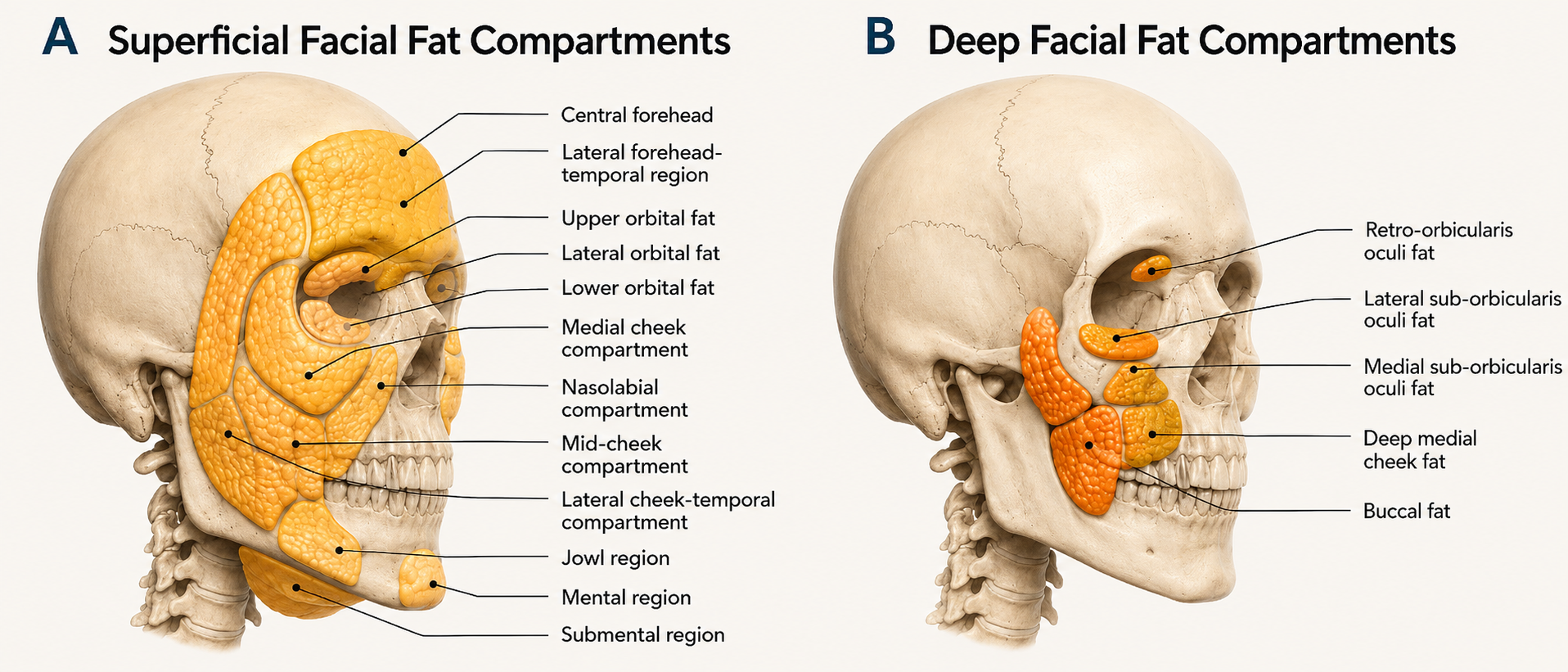
Facial fat is not one single smooth layer. It is organized into different compartments throughout the face. Some compartments are more superficial, while others sit deeper beneath the skin and soft tissue.
With age, these fat compartments may lose volume, shift position, or become more noticeable in certain areas. In the lower face, this can contribute to jowls, fullness near the jawline, and a softer transition between the face and neck.
This is one reason why lower face aging can look different from person to person. Some patients may mainly have skin laxity. Others may have more localized fat under the chin or along the jawline. Some may have both. Understanding these differences is important when choosing the right treatment approach.
The Role of Collagen and Skin Laxity
Collagen is one of the key proteins responsible for skin firmness and strength. As collagen production slows with age, the skin gradually becomes thinner, less elastic, and less resilient. This can make the lower face more vulnerable to looseness, especially around the jawline, chin, and neck.
Skin laxity can also make existing fullness look more noticeable. Even a small amount of fat under the chin or along the lower face can appear more prominent when the surrounding skin is no longer as firm.
Patients may describe this as loose skin, mild sagging, soft jawline definition, a double chin, or a heavier lower face. Although these concerns can look similar from the outside, the underlying cause may vary from person to person.
Where Endolaser May Fit In
Endolaser is a minimally invasive treatment that may help address selected concerns related to localized fat and mild to moderate skin laxity. It is often considered for areas such as the jawline, jowls, double chin, lower face, and neck.
Unlike treatments that only work on the surface, Endolaser is designed to work beneath the skin. By targeting localized fat and supporting tissue tightening, it may help improve the appearance of facial contour and firmness. The treatment may also support collagen remodeling, which can contribute to a smoother and tighter-looking lower face over time.
For patients who are bothered by early jowls, jawline softening, or mild lower face heaviness, Endolaser may be part of a customized rejuvenation plan. Depending on the patient’s anatomy and goals, it may also be combined with other treatments such as PDO threads, injectables, or skin rejuvenation procedures.
Why a Personalized Consultation Matters
Not every lower face concern comes from the same cause. Some patients have more skin laxity. Others have more localized fat under the chin or around the jawline. Some have volume changes in the midface that make the lower face look heavier.
Because facial aging is layered, the best treatment plan should be based on a careful evaluation of facial structure, tissue quality, and personal goals. A consultation can help determine whether the concern is mainly related to skin laxity, localized fat, collagen loss, facial support, or a combination of these factors.
Lower Face Rejuvenation at Aura Medical Wellness
At Aura Medical Wellness in Orlando, our approach focuses on natural-looking improvement rather than overcorrection. During a consultation, we evaluate the lower face, jawline, chin, and neck to determine whether Endolaser may be appropriate, or whether a combination approach would better support the patient’s desired result.
Lower face aging is not just about getting older. It is about how the deeper structures of the face, the fat compartments, the collagen network, and the skin envelope change together over time. By understanding these changes, patients can make more informed decisions about treatments that support a firmer, more defined, and refreshed-looking contour.
Reference
Swift A, Liew S, Weinkle S, Garcia JK, Silberberg MB. The Facial Aging Process From the “Inside Out.” Aesthetic Surgery Journal Open Forum. 2021.
This article is also informed by anatomical concepts related to facial fat compartments, collagen loss, skin laxity, and layered facial aging.
